
Naming explained: how to create a brand name people will remember, find and be able to register
Naming is the process of creating a brand name. 10 methods, 5 stages from brief to registration, the criteria of a strong name, common mistakes and case studies.

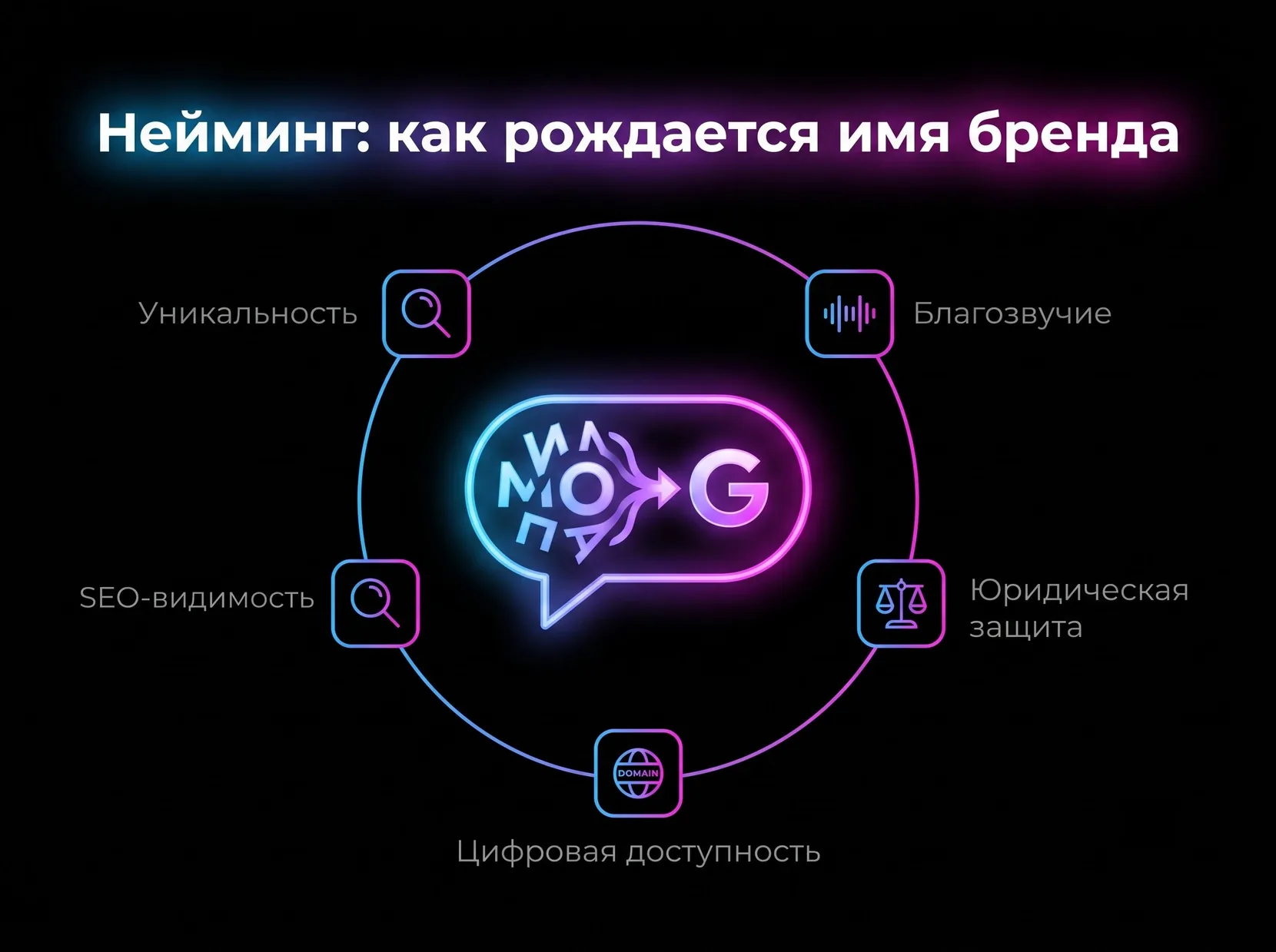
Naming is the process of creating a name for a brand, product or company. It sounds like “just coming up with a nice word”, but a professional approach involves market analysis, generating dozens of options, linguistic screening, testing with the target audience and trademark registration — a whole chain of steps rather than a single flash of inspiration over a cup of coffee.
A brand’s name is the first thing people encounter, before they even get to know the product. A good name works like a business card: it speaks for the company before the company has had a chance to say a word.
Key takeaways:
- Naming is a systematic process, not the result of a sudden burst of inspiration.
- A strong name meets five sets of criteria: marketing, linguistic, legal, digital and SEO.
- The full journey from idea to registration takes five stages — from the brief to the trademark certificate.
- Ten name-generation techniques give you a foundation for producing dozens of options.
- Before making the final decision, “try the name on” — put it into a logo, a shop sign and a domain to see how it looks in a real context.
What is naming: a definition and its place in marketing
Naming isn’t about dreaming up a pretty word in an evening. It’s a strategic tool that sits alongside visual identity and brand positioning — the three pillars that support all of a company’s communication with its market.
In the 19th century, brands were simply named after their founders — Heinz, Cadbury — and that was enough to stand out among a handful of competitors. Once the market filled up with thousands of similar products, a surname was no longer enough, and a separate profession emerged: the namer, a specialist in creating names. Today everyone can think of successful examples: Yandex, Dodo Pizza, Amazon — names that stuck on their own, even before people first tried the product.
Why a name is more than just a word
A name triggers a chain of associations in the target audience before anyone has opened the company’s website or picked the product off the shelf. Unfortunate international examples make this clear: the French baby food brand Bledina and the Dermo-Expertise cosmetics line sound odd or unpleasant to Russian speakers, which creates a barrier where there shouldn’t be one.
A good name works in several directions at once:
- it triggers the right associations before any contact with the product;
- it is easy to remember and pass on — word of mouth only works with names that roll off the tongue;
- it shapes the first impression of the brand’s character;
- it sets the company apart from competitors both visually and aurally;
- it becomes the foundation for the logo, the slogan and the entire visual identity.
What a namer does and when you need one
A namer works at the intersection of several disciplines: linguistics, marketing, psychology, law and cross-cultural communication. It’s a rare combination of skills that sets a namer apart from a regular copywriter, whose job is limited to writing copy.
Why a business needs good naming: the real value
A brand name isn’t just a line in the company details — it’s an intangible asset whose value grows along with the company’s reputation. A good name pays off in three ways at once, making it an investment that delivers returns at every level of the business.
- Competitive value. A unique name makes a company stand out among dozens of similar players and is instantly understood by the right audience without any extra explanation. A generic name like “StroyService” (roughly “Construction Service”) gets lost in the crowd, while a memorable one grabs attention straight away and stays in the customer’s mind.
- Legal and financial value. A registered name becomes a trademark — an intangible asset that can be protected, sold or used as collateral. Without registration, even a well-known name remains vulnerable: a competitor could register a similar name first.
- Strategic value. This is where the “descriptiveness trap” lies: an overly literal name limits a company’s growth. The classic example is Boston Chicken, a chain originally named after its rotisserie chicken; when the menu expanded, it had to rebrand as Boston Market so that the name wouldn’t confine the business to a single dish.
Principles and criteria of a strong name
The criteria of a strong name are a professional checklist, not a matter of gut feeling. These are the criteria a namer uses when making the final selection, and they will also help you evaluate any name you come up with yourself. They fall into three groups: marketing, linguistic, and legal plus digital.
Marketing criteria: memorability, euphony, associations
There are five basic requirements for a strong name: relevance to the product, uniqueness in the market, easy recall, a pleasant sound and positive associations for the audience.
There’s a simple “taxi test”: if you have to repeat the name to a taxi driver twice before they write down the address correctly, the name has failed. Yandex, Tinkoff and Dodo Pizza are remembered the first time you hear them for exactly this reason — they are short, rhythmic and easy on the ear.
Linguistic criteria: phonetics, morphology, hidden meanings
Euphony, transparent morphology (a word form that is easy to inflect and doesn’t grate on the ear) and the absence of negative meanings in other languages are the three cornerstones of linguistic screening. Skip this stage and the result can be comical or even offensive in another market: the Chevrolet Nova sounded like “doesn’t go” (no va) in Spanish-speaking markets, and Russia’s Lada Kalina puzzled Finnish buyers — in Finnish, “kalina” means “rattling” or “clatter”.
In our experience, linguistic analysis weeds out roughly 20–30% of the finalists before they even reach audience testing — a figure that shows just how important this step is.
Legal, digital and SEO criteria
Three checks without which a final decision is risky:
- Uniqueness as a trademark — in Russia, this is checked on the website of Rospatent (the Federal Service for Intellectual Property) or in the database of FIPS (the Federal Institute of Industrial Property) to make sure nobody has claimed the name yet.
- Domain and social media availability — checked with services such as whois, so that the name matches the brand’s online address.
- Uniqueness in search results — if the chosen name is a common everyday word, the brand literally drowns among irrelevant search results.
A practical tip: before making your final choice, type the name into Google. If the first page of results is filled with unrelated content rather than your future website, it’s worth looking for another option.
| Criterion | What we check | Good example | Bad example |
|---|---|---|---|
| Memorability | The taxi test | Tinkoff | StroyTrest-MosInvest |
| Euphony | Phonetics in different languages | Kodak | Bledina |
| Uniqueness | Rospatent search | Delimobil | A competitor’s name |
| SEO visibility | Google search | Yandex | “Stroy” (a common word for “build”) |
| Scalability | Room for business growth | Amazon | Boston Chicken |
Types of names: which one suits your business
The five types of names serve different strategic goals — from instantly conveying what the product is to maximum uniqueness in the market.
- Descriptive — names that state what the product is directly, such as StroyMaster (“BuildMaster”). The upside is that customers immediately understand what the company does; the downside is that it’s hard to expand beyond the original niche.
- Associative — names that evoke an image indirectly linked to the product, the way Amazon refers to the scale of the river it is named after.
- Eponymous — names built on the founder’s surname or first name, like Disney or Ford.
- Neologisms — completely invented words, like Yandex or Kodak. These names are as unique as it gets, but they require substantial promotion budgets: at the start, nobody knows what the new word means.
- Acronyms — abbreviations made from initial letters, like BMW or MIF.
For a small business, a descriptive or associative name is the more sensible choice: unlike neologisms, these don’t require years of investment to build recognition from scratch.
If the name is only the first step and you still need a logo and a complete visual identity for the company, the Veonix team offers end-to-end corporate identity design, from the name concept to a finished brand book.
Naming stages: a step-by-step process from brief to registration
The professional naming standard is built on five consecutive stages — from defining the task to the final trademark registration.
Stage 1. The brief and defining the task
Without a clear brief, the team is shooting in the dark and hoping to hit the target by chance. Key questions for the brief:
- What exactly is the product or service we are naming?
- Who is the target audience and what matters to them?
- What is the brand’s tone of voice — serious, friendly, bold?
- What geography is the business aiming at — a local market or the whole country?
- Who are the main competitors and what are they called?
- What budget has been set aside for naming and registration?
- What is the timeline for the whole process?
- Are there any restrictions — for example, forbidden words or associations?
Stage 2. Market and competitor analysis
The goal of this stage is to find the “white spaces” on the map of existing names in the niche. You gather all the competitors’ names, classify them by the types described in the previous section and identify the dominant patterns. For example, if half of Russia’s car-sharing market uses foreign words, a Russian-sounding name like Delimobil gives you a chance to stand out.
Stage 3. Generating ideas: methods and brainstorming rules
The rule is simple: quantity first, quality later. At the start you generate 50–100 options or more, and filtering comes afterwards. The “semantic field” technique works well here: you collect every word linked to the product by meaning, sound or image, and use them as a springboard for new options.
Online generators such as Genlogo or Namelix can help sketch out rough ideas, but they can’t replace a proper creative process. A practical hack: instead of one long session, hold three short ones with breaks in between — a fresh look after a pause often produces better options than a single marathon.
Stage 4. Shortlisting and audience testing
Shortlisting happens in two steps: first, filtering against the criteria from the previous sections, then a mini-test with the target audience — usually 5–7 questions and 10–15 respondents are enough for an initial check. The key principle here is to judge not whether you personally like the name, but whether it works for the audience’s perception, because the author’s personal taste and the market’s reaction often diverge.
Stage 5. Legal clearance and registration
In Russia, the final chain looks like this: a preliminary search in the FIPS database → filing an application with Rospatent → passing the examination → receiving the trademark certificate. Skipping this stage risks fines and a forced rebrand if it turns out that the name is already taken by another company.
A sensible tip: start the legal check in parallel with shortlisting to save time. And keep two or three finalists in reserve in case your first choice turns out to be taken — redoing the whole process from scratch costs far more than having a plan B ready. The cost of registering a trademark is nothing compared with the cost of a full company rebrand if the problem surfaces after launch.
Naming methods: 10 techniques for creating a name, with examples
The best names are born where several techniques meet. Here are ten proven methods with examples from well-known brands:
- Metaphor — Amazon, referring to the scale of the river.
- Alliteration — Coca-Cola, a catchy repetition of consonants.
- Neologism — Yandex, Kodak, completely invented words.
- Acronym — BMW, MIF, abbreviations made from initial letters.
- Truncation — Intel, short for Integrated Electronics.
- Analogy — Jaguar, evoking the animal’s speed and grace.
- Descriptive method — StroyMaster, a direct reference to what the business does.
- Toponym — Nokia, the name of the Finnish town where the company started.
- Allusion — Nike, the name of the ancient Greek goddess of victory.
- Onomatopoeia — Schweppes, a sound that imitates the fizz of the drink.
Neologisms and acronyms are particularly interesting. The former offer maximum uniqueness, provided you invest heavily in promotion; the latter are compact and easy to remember, but the meaning behind the letters must not get lost over time — many people no longer remember what BMW stands for (Bayerische Motoren Werke, “Bavarian Motor Works”).
Naming mistakes: what kills a brand before it launches
Most naming mistakes are irreversible — fixing them costs many times more than getting the process right from the start.
- A name that is too long or complicated — it fails the taxi test instantly. The longer the word, the lower the chance that people will repeat it correctly.
- A descriptive name that blocks growth — the company hits the limits of its original niche, as in the Boston Chicken story.
- Negative connotations in other languages — linguistic analysis at the outset saves you from a situation like the Chevrolet Nova.
- An unregistered trademark — the FIPS check should happen during shortlisting, not after sales have started.
- A name only the founder understands — testing with the target audience reveals such blind spots in advance.
- A name that matches a common word — the brand literally gets lost in search results; a Google check solves this problem before registration.
Good and bad naming: case studies
| Name | Method | Why it works or doesn’t |
|---|---|---|
| Yandex | Neologism | Unique in search results, easy to remember |
| VkusVill | Descriptive | The essence of the brand is grasped instantly |
| Dodo Pizza | Alliteration | The rhythmic sound makes it easy to remember |
| Delimobil | Associative | Conveys what the service is without extra words |
| Bledina | — | Negative connotations for Russian speakers |
| Chevrolet Nova | — | “Doesn’t go” in Spanish — a fatal translation mistake |
| StroyTrest-MosInvest | — | Fails the taxi test because of its length and complexity |
| Amazon | Metaphor | The scale of the name matches the ambitions of the business |
Every success in the table met all the criteria above — from euphony to a search results check — while every failure broke one or more principles at once.
If, after reading this article, you’d rather not invent a name from scratch yourself and want a ready-made solution that has been fully vetted, it makes sense to turn to professionals: Veonix studio provides logo and brand identity design, including naming as part of comprehensive brand development.
Frequently asked questions
How long does the full naming process usually take?
It usually takes one to three months to get from the brief to a registered trademark. Most of that time goes on the legal examination at Rospatent (in Russia), not on generating ideas.
Can a Russian brand use a foreign word as its name?
Yes, but only after checking how the word sounds and what it means in several languages — the Lada Kalina story shows that a word that is neutral in one language can sound odd or comical in another.
What if the name you like is already taken?
Keep two or three alternative finalists in reserve from the testing stage onwards — then switching to a backup option doesn’t mean restarting the whole process from scratch.
Does a small local business really need to hire a namer?
Not necessarily — the principles and the step-by-step process in this article can be applied on your own for a local project. A specialist becomes necessary when you scale up to a national level.
How do you check that a name doesn’t infringe someone else’s trademark?
In Russia, use the official Rospatent website or the FIPS database: a preliminary search of the register takes just a few minutes and immediately shows whether the chosen name is available.